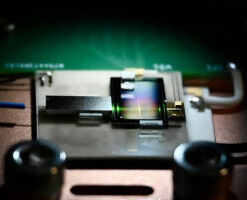
A new microscopy tool promises to revolutionize nanoscale imaging. Left, a design schematic of the so-called "campanile" microscopy tip. Right, an electron micrograph of the tip and, inset, the UC Berkeley campanile bell-tower for which it is named.
If nanoscience were television, we'd be in the 1950s. Although scientists can make and manipulate nanoscale objects with increasingly awesome control, they are limited to black-and-white imagery for examining those objects. Information about nanoscale chemistry and interactions with light-the atomic-microscopy equivalent to color-is tantalizingly out of reach to all but the most persistent researchers. But that may all change with the introduction of a new microscopy tool from researchers at the Department of Energy (DOE)'s Lawrence Berkeley National Laboratory (Berkeley Lab) that delivers exquisite chemical details with a resolution once thought impossible. The team developed their tool to investigate solar-to-electric energy conversion at its most fundamental level, but their invention promises to reveal new worlds of data to researchers in all walks of nanoscience. "We've found a way to combine the advantages of scan/probe microscopy with the advantages of optical spectroscopy," says Alex Weber-Bargioni, a scientist at the Molecular Foundry, a DOE nanoscience center at Berkeley Lab. "Now we have a means to actually look at chemical and optical processes on the nanoscale where they are happening." Weber-Bargioni is corresponding author of a paper reporting The paper is titled, "Mapping local charge recombination heterogeneity by multidimensional nanospectroscopic imaging." Co-authoring the paper are Wei Bao, Mauro Meli, Frank Ogletree, Shaul Aloni, Jeffrey Bokor, Stephano Cabrini, Miquel Salmeron, Eli Yablonovitch, and James Schuck of Berkeley Lab; Marco Staffaroni of the University of California, Berkeley; Hyuck Choo of Caltech; and their colleagues in Italy, Niccolo Caselli, Francesco Riboli, Diederik Wiersma, and Francesca Intoni.
TO READ THIS ARTICLE, CREATE YOUR ACCOUNT
And extend your reading, free of charge and with no commitment.