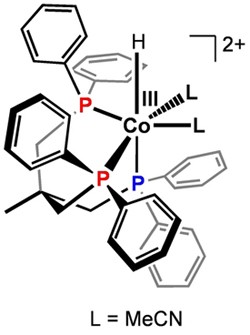
Gray’s group added a set of ligands to cobalt, slowing the reaction so that they could observe a key intermediate and then determine the chemical mechanism.
Scientists and engineers around the world are working to find a way to power the planet using solar-powered fuel cells. Such green systems would split water during daylight hours, generating hydrogen (H2) that could then be stored and used later to produce water and electricity. But robust catalysts are needed to drive the water-splitting reaction. Platinum catalysts are quite good at this, but platinum is too rare and expensive to scale up for use worldwide. Several cobalt and nickel catalysts have been suggested as cheaper alternatives, but there is still plenty of room for improvement. And no one has been able to determine definitively the mechanism by which the cobalt catalysts work, making it difficult to methodically design and construct improved catalysts. Now chemists at the California Institute of Technology (Caltech) have determined the dominant mechanism for these cobalt catalysts.
TO READ THIS ARTICLE, CREATE YOUR ACCOUNT
And extend your reading, free of charge and with no commitment.