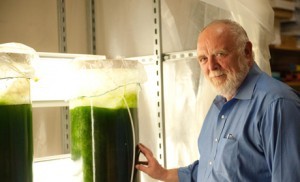
Robert Hebner, director of the university's Center for Electromechanics (CEM), conducts research in a large algae growth demonstration facility for biofuels. The facility is located adjacent to CEM.
AUSTIN, Texas — It's theoretically possible to produce about 500 times as much energy from algae fuels as is needed to grow the fuels, according to a new study by researchers at The University of Texas at Austin. However, limited by existing technology, the researchers found in a separate study that their algae growing facility is getting out about one-five hundredth as much energy as it currently puts in to grow the fuels. "The search for cost-effective biofuels is one of the noble endeavors of our time, and these papers shed insight on where the boundaries are in algae research," said Robert Hebner , a professor in the Cockrell School of Engineering and director of the Center for Electromechanics. "One of the responsibilities of a top research university is to discover and explain what the boundaries are so we can innovate within those boundaries or create ways to expand them." The findings were announced in three new studies published in June and co-authored by Hebner, Cockrell School Assistant Professor Michael Webber and researcher Colin Beal. The studies add important context to the viability of algae, which shows promise for producing large amounts of energy-dense fuel because it can be harvested nearly continuously all year. Algae can also be used for fertilizers, food, pharmaceuticals and more, but researchers must first figure out how to mass-produce the green source inexpensively. Numerous studies have focused on the energy efficiency of algae, but limited comprehensive data is available.
TO READ THIS ARTICLE, CREATE YOUR ACCOUNT
And extend your reading, free of charge and with no commitment.