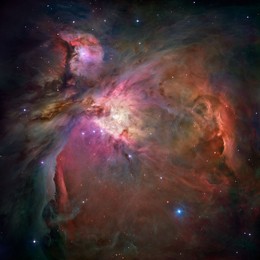
Hubble Panoramic View of Orion Nebula, courtesy of hubblesite.org
New research from The Australian National University has answered a decades old cosmic conundrum on how 'chondrules' - tiny particles found within meteorites - could have formed in extreme heat, especially when the meteorite structure surrounding them remained cold. Chondrules are spherical particles of molten material found in meteorities but their origins have long been a mystery. No longer than about 1mm in diameter, they melted at temperatures of more than 1000 degrees Celsius, while the cooler materials surrounding them only experienced temperatures of a few hundred degrees Celsius. ANU researchers Raquel Salmeron from the Research School of Astronomy and Astrophysics, and Trevor Ireland from the Research School of Earth Sciences, have proposed a new theory as to how chondrules formed in the early solar system. "Most of the solar system is cold, so it's been unclear for decades what caused the chondrules to experience such extreme heat. We believe that chondrules formed in jets of material ejected from flattened disks, called 'protostellar disks', which encircle young stars," Salmeron said. "These disks are somewhat like the rings around the planet Saturn.
TO READ THIS ARTICLE, CREATE YOUR ACCOUNT
And extend your reading, free of charge and with no commitment.