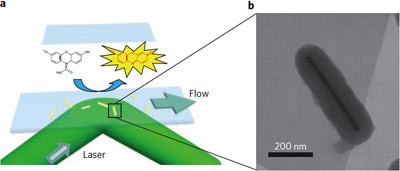
When Amplex Red connects with a gold catalyst the structure is changed to make a fluorescent molecule that immediately emits a flash of light, showing where the catalytic event took place. Right, electron microphoto of a single gold nanorod, encased in a poirus silica shell. The shell keeps rods from clumping together and allows experimenters to use heat to clean away a coating that forms when the rods are created.
Engineers trying to improve fuel-cell catalysts may be looking in the wrong place, according to new research at Cornell. There is growing interest in forming the catalysts that break down fuel to generate electricity into nanoparticles. Nanoparticles provide a larger surface area to speed reactions, and in some cases, materials that are not catalytic in bulk become so at the nanoscale. These nanoparticles, typically just a few tens of nanometers (nm) wide, are not neat little spheres, but rather jagged chunks, like microscale gravel, and researchers have found that they can correlate catalytic activity with information about the number and type of their surface facets. But they may be looking at the forest and ignoring the trees. "People measure the activity of a sample and then try to understand by using facet information," said Peng Chen, associate professor of chemistry and chemical biology. "The message we want to deliver is that surface defects [on the facets] dominate the catalysis." Chen's research is reported Feb.
TO READ THIS ARTICLE, CREATE YOUR ACCOUNT
And extend your reading, free of charge and with no commitment.