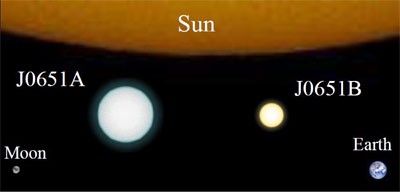
The white dwarfs J0651A and J0651B have the shortest orbital period of any known pair of stars that are completely detached from each other. They orbit each other every 12.75 minutes.
Theoretical physicists at Cornell may have found a new way to explain the formation of novae, stars that suddenly become very bright then quickly fade. At the heart of the theory is a pair of old, dense stars called white dwarfs, orbiting each other so closely that their gravitational forces create violent tidal waves of plasma that break near the surfaces of the stars. The phenomenon is what the researchers have dubbed a tidally induced nova. If their theory is correct, it would represent a big step forward for astrophysics, said lead researcher Jim Fuller, a Ph.D. candidate in the field of astronomy and space sciences. "It's an important problem because there are a lot of white dwarfs in tight binaries," said Fuller, who co-wrote the study with Dong Lai, professor of astronomy. "They're spiraling in toward each other, so tidal effects are going to be very important, but no one has really studied that." The types of white dwarfs Fuller and Lai have been researching orbit each other very quickly, in less than half an hour.
TO READ THIS ARTICLE, CREATE YOUR ACCOUNT
And extend your reading, free of charge and with no commitment.