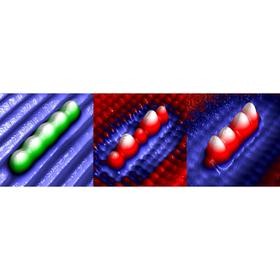
scanning tunnelling
microscopy (STM) images of the quantum states of an artificial atomic defect tructure in silicon. This structure was
fabricated by using the STM to individually remove five hydrogen atoms from a
hydrogen-terminated silicon (001) surface. The absence of the hydrogen atoms
creates "dangling bond" states that interact to form extended, artificial
molecular orbitals. Only the imaging
bias voltage has been changed in the three images shown (from left to right,
-1.4, +1.4, and +1.8 Volts).
By introducing individual silicon atom 'defects' using a scanning tunnelling microscope, scientists at the London Centre for Nanotechnology have coupled single atoms to form quantum states. , the study demonstrates the viability of engineering atomic-scale quantum states on the surface of silicon - an important step toward the fabrication of devices at the single-atom limit. Advances in atomic physics now allow single ions to be brought together to form quantum coherent states. However, to build coupled atomic systems in large numbers, as required for applications such as quantum computing, it is highly desirable to develop the ability to construct coupled atomic systems in the solid state. Semiconductors, such as silicon, routinely display atomic defects that have clear analogies with trapped ions. However, introducing such defects deterministically to observe the coupling between extended systems of individual defects has so far remained elusive. Now, LCN scientists have shown that quantum states can be engineered on silicon by creating interacting single-atom defects.
TO READ THIS ARTICLE, CREATE YOUR ACCOUNT
And extend your reading, free of charge and with no commitment.