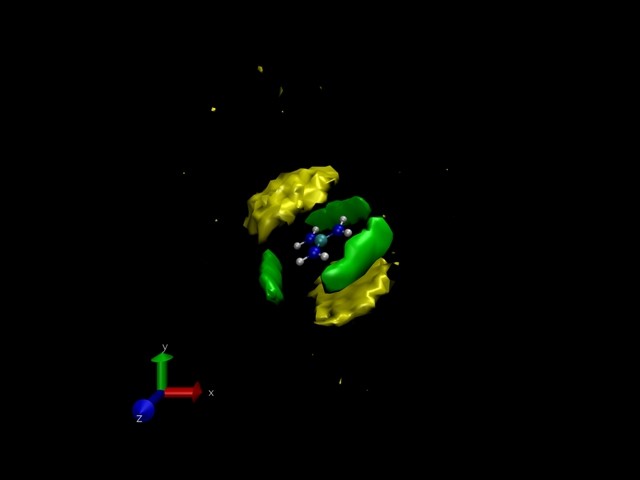
This model of the guanidinium chloride salt (blue and silver) in solution shows carbon (yellow) and water (green) surrounding the cations and demonstrates cation-cation pairing.
At some point in elementary school you were shown that opposite charges attract and like charges repel. This is a universal scientific truth - except when it isn't. A research team led by Berkeley Lab chemist Richard Saykally and theorist David Prendergast, working at the Advanced Light Source (ALS), has shown that, when hydrated in water, positively charged ions (cations) can actually pair up with one another. "Through a combination of X-ray spectroscopy, liquid microjets and first principles' theory, we've observed and characterized pairing between guanidinium cations in aqueous solution," Saykally says. "Theorists have predicted this cation-to-cation pairing but it has never been definitively observed before. If guanidinium cations can pair this way, then other similar cation systems probably can too." Guanidinium is an ionic compound of hydrogen, nitrogen and carbon atoms whose salt - guanidinium chloride - is widely used by scientists to denature proteins for protein-folding studies. This practice dates back to the late 19th century when the Czech scientist Franz Hofmeister observed that cations such as guanidinium can pair with anions (negatively charged ions) in proteins to cause them to precipitate.
TO READ THIS ARTICLE, CREATE YOUR ACCOUNT
And extend your reading, free of charge and with no commitment.