Model of Sun’s magnetic field
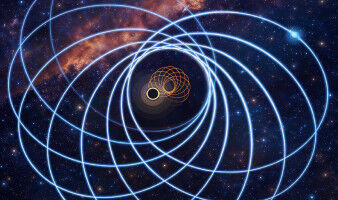
Researchers at the Universities of Leeds and Chicago have uncovered an important mechanism behind the generation of astrophysical magnetic fields such as that of the Sun. Scientists have known since the 18th Century that the Sun regularly oscillates between periods of high and low solar activity in an 11-year cycle, but have been unable to fully explain how this cycle is generated. In the ‘Information Age’, it has become increasingly important to be able to understand the Sun’s magnetic activity, as it is the changes in its magnetic field that are responsible for ‘space weather’ phenomena, including solar flares and coronal mass ejections. When this weather heads in the direction of Earth it can damage satellites, endanger astronauts on the International Space Station and cause power grid outages on the ground. The research providing a solution to the mathematical equations governing fluids and electromagnetism for a large astrophysical body. The mechanism, known as a dynamo, builds on a solution to a reduced set of equations first proposed in the 1950s which could explain the regular oscillation but which appeared to break down when applied to objects with high electrical conductivity. The mechanism takes into account the ‘shear’ effect of mass movement of the ionised gas, known as plasma, which makes up the Sun.