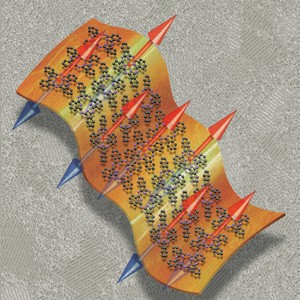
Phthalocyanine thin film on a flexible plastic substrate, showing the
coexistence of long-lived "0" and "1" qubits on the copper spin. The
molecules form a regular array together with the metal-free analogues,
and the background represents the lattice fringes of the molecular
crystals obtained by transmission electron microscopy.
A common blue pigment used in the £5 note could have an important role to play in the development of a quantum computer, according to a paper published today in the journal Nature . The pigment, copper phthalocyanine (CuPc), which is similar to the light harvesting section of the chlorophyll molecule, is a low-cost organic semiconductor that is found in many household products. Crucially, it can be processed into a thin film that can be readily used for device fabrication, a significant advantage over similar materials that have been studied previously. Now, researchers from the London Centre for Nanotechnology at UCL and the University of British Columbia have shown that the electrons in CuPc can remain in 'superposition' - an intrinsically quantum effect where the electron exists in two states at once - for surprisingly long times, showing this simple dye molecule has potential as a medium for quantum technologies. The development of quantum computing requires precise control of tiny individual "qubits", the quantum analogs of the classical binary bits, '0' and '1', which underpin all of our computation and technologies today. What distinguishes the "qubits" from classical bits is their ability to exist in superposition states. The decay time of such superpositions tells us how useful a candidate qubit could be in quantum technologies.
TO READ THIS ARTICLE, CREATE YOUR ACCOUNT
And extend your reading, free of charge and with no commitment.