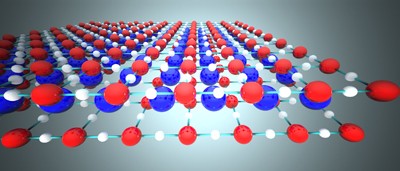
A rendering of the infinite layer cuprate superconductor structure. White is oxygen, red is copper and blue is strontium or lanthanum.
When it comes to high-temperature superconductors, a class of materials called cuprates is king, and it is science's ongoing quest to determine their exact physical subtleties. Cornell physicists and materials scientists have now verified that cuprates respond differently when adding electrons versus removing them, resolving a central issue about the compounds' most fundamental properties. The multidisciplinary study was a collaboration led by graduate student John Harter; visiting Luigi Maritato of the University of Salerno, Italy; and senior authors Darrell Schlom, the Herbert Fisk Johnson Professor of Industrial Chemistry, and Kyle Shen, assistant professor of physics, both members of the Kavli Institute at Cornell for Nanoscale Science, and published Dec. 27 in Physical Review Letters. The study describes the behavior of a strontium-lanthanum copper oxide cuprate superconductor when chemically "doped" with electrons, meaning more electrons are introduced into their two-dimensional copper-oxygen sheets, where superconductivity is known to reside. When cooled to about 100 Kelvin (-280 Fahrenheit), the electrons in these sheets undergo a phase transition and become superconducting, which means electrons can flow freely through them without resistance. The cuprates are the highest-temperature class of superconductors known - "high temperature" by physicists' standards, anyway.
TO READ THIS ARTICLE, CREATE YOUR ACCOUNT
And extend your reading, free of charge and with no commitment.