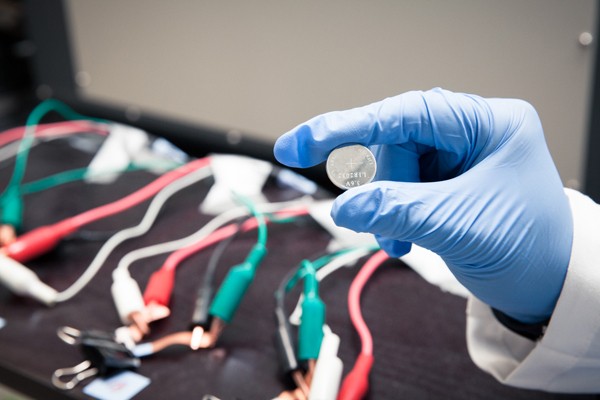
This prototype lithium ion battery contains a silicon electrode protected with a coating of self-healing polymer. The cables and clips in the background are part of an apparatus for testing the battery’s performance.
A team of Stanford and SLAC scientists has made the first battery electrode that heals itself, opening a potentially commercially viable path for making the next generation of lithium ion batteries for electric cars, cell phones and other devices. Researchers have made the first battery electrode that heals itself, opening a new and potentially commercially viable path for making the next generation of lithium ion batteries for electric cars, cell phones and other devices. The secret is a stretchy polymer that coats the electrode, binds it together and spontaneously heals tiny cracks that develop during battery operation, said the team from Stanford University and the Department of Energy's SLAC National Accelerator Laboratory. They reported the advance in the Nov. 19 issue of Nature Chemistry . "Self-healing is very important for the survival and long lifetimes of animals and plants," said Chao Wang, a postdoctoral researcher at Stanford and one of two principal authors of the paper. "We want to incorporate this feature into lithium ion batteries so they will have a long lifetime as well." Chao developed the self-healing polymer in the lab of Zhenan Bao , a professor of chemical engineering at Stanford, whose group has been working on flexible electronic skin for use in robots, sensors, prosthetic limbs and other applications.
TO READ THIS ARTICLE, CREATE YOUR ACCOUNT
And extend your reading, free of charge and with no commitment.