Young stars, exploding supernovae, and active black holes produced powerful winds 10 billion to 12 billion years ago. These winds were the spoon that lifted the iron from the galaxies and mixed it with the intergalactic gas.
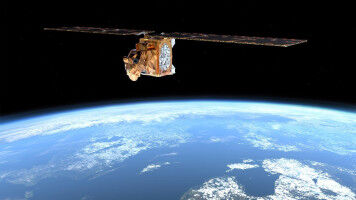
By detecting an even distribution of iron throughout a massive galaxy cluster, astrophysicists can tell the 10-billion-year-old story of how exploding stars and black holes sowed the early cosmos with heavy elements New evidence that iron is spread evenly between the galaxies in one of the largest galaxy clusters in the universe supports the theory that the universe underwent a turbulent and violent youth more than 10 billion years ago. That explosive period was responsible for seeding the cosmos with iron and other heavy elements that are critical to life itself. Researchers from the Kavli Institute for Particle Astrophysics and Cosmology (KIPAC), jointly run by Stanford University and the Department of Energy's SLAC National Accelerator Laboratory, shed light on this important era by analyzing 84 sets of X-ray telescope observations from the Japanese-US Suzaku satellite. Their results appear in the Oct. 31 issue of the journal Nature . In particular, the researchers looked at iron distribution throughout the Perseus cluster, a large grouping of galaxies about 250 million light-years away. "We saw that iron is spread out between the galaxies remarkably smoothly," said Norbert Werner, an astrophysicist at KIPAC and lead author of the paper.
TO READ THIS ARTICLE, CREATE YOUR ACCOUNT
And extend your reading, free of charge and with no commitment.