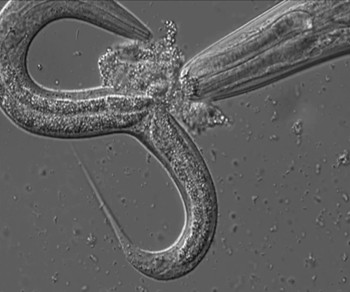
A wide-mouthed P. pacificus worm preying on a smaller C. elegans worm.
Conventional wisdom holds that genes determine the shape and structure (morphology) of animals, but something else may be at play. A new study shows that a roundworm ( P. pacificus) regulates its offspring's morphology by using a potent cocktail of small-molecule signals. Exposure to trace quantities of these chemically unusual molecules can turn genetically identical juveniles into very different types of adults. The study, co-authored by Frank Schroeder of the Boyce Thompson Institute for Plant Research at Cornell and Ralf Sommer of the Max-Planck Institute in Germany, was published in the Dec. 14 issue of Angewandte Chemie, a peer-reviewed journal of the German Chemical Society . Schroeder investigated the development of the nematode P. pacificus , which can either have a narrow or a wide, large-toothed mouth. The wide-mouthed form had been shown to be associated with low food availability and facilitates a predacious lifestyle: These worms are well equipped to kill and eat other nematodes.
TO READ THIS ARTICLE, CREATE YOUR ACCOUNT
And extend your reading, free of charge and with no commitment.