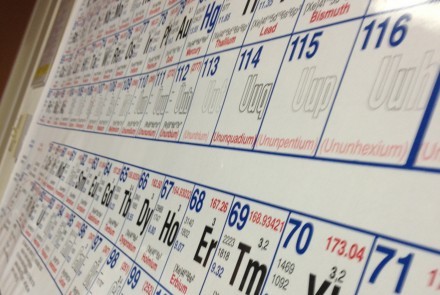
Image by Brian Cantoni, flickr.
The stage is set for a new, super-heavy element to be added to the periodic table following research published in the latest Physics Review Letters, by a multinational team of physicists and chemists, including researchers from The Australian National University. Led by researchers at Germany's GSI laboratory, the team created atoms of element 117, matching the heaviest atoms ever observed, which are 40 per cent heavier than an atom of lead. "Making element 117 is at the absolute boundary of what is possible right now," says Professor David Hinde, Director of the Heavy Ion Accelerator Facility operated by the ANU Nuclear Physics Department. "That's why it's a triumph to create and identify even a few of these atoms." The periodic table includes every known element, from the lightest substances, hydrogen and helium, through to super-heavy elements, nearly 300 times heavier than hydrogen. Each chemical element is defined by the number of protons in its nucleus. The new element has 117 protons, hence its temporary name. Super-heavy atoms such as element 117 have not been found in nature, but can be made by fusing together the nuclei of smaller atoms that combine to give the right number of protons.
TO READ THIS ARTICLE, CREATE YOUR ACCOUNT
And extend your reading, free of charge and with no commitment.