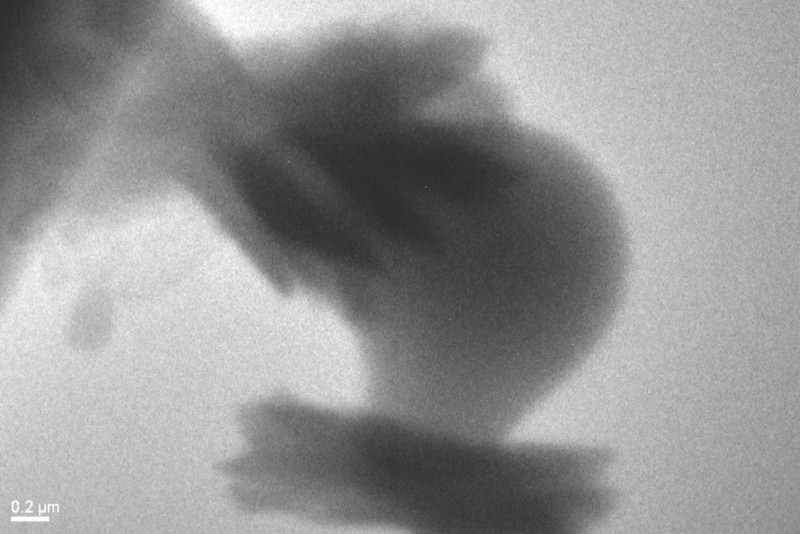
These crystals of aragonite, with the characteristic “sheaf of wheat” form, grew on the surface of a particle of amorphous calcium carbonate. Credit: Science
New insights into the formation of calcium carbonate could lead to processes that trap atmospheric carbon dioxide and store it in rock. Found in seashells, pearls, marble, and chalk, calcium carbonate is one of the most important molecules on Earth. It is also the most abundant form of carbon on our planet. But while scientists have studied calcium carbonate crystal growth for decades, they haven't actually been able to explain how the crystals appear from the very start. Now, researchers from Lawrence Berkeley National Laboratory (Berkeley Lab), the University of California Berkeley, and Pacific Northwest National Laboratory (PNNL) have used a high-powered electron microscope to capture the birth of these crystals, a phenomenon called nucleation. In doing so, they've demonstrated that pathways to different types of crystallization are varied and more complex than suspected. It's a first step, the researchers say, to better understanding how excess carbon dioxide might be pulled from the air and stored it in rock where it wouldn't contribute to global warming.
TO READ THIS ARTICLE, CREATE YOUR ACCOUNT
And extend your reading, free of charge and with no commitment.