Haofei Wei
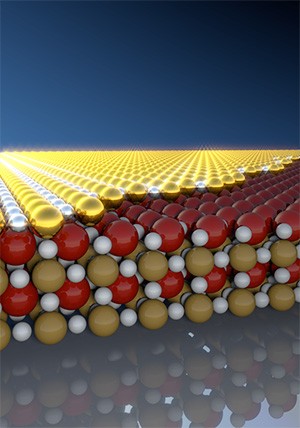
Ever-shrinking electronic devices could get down to atomic dimensions with the help of transition metal oxides, a class of materials that seems to have it all: superconductivity, magnetoresistance and other exotic properties. These possibilities have scientists excited to understand everything about these materials, and to find new ways to control their properties at the most fundamental levels. Researchers from Cornell and Brookhaven National Laboratory have shown how to switch a particular transition metal oxide, a lanthanum nickelate (LaNiO3), from a metal to an insulator by making the material less than a nanometer thick. The team, which published its findings in the April , includes lead researcher Kyle Shen, associate professor of physics; first author Phil King, a recent Kavli postdoctoral fellow at Cornell now on the faculty at the University of St. Andrews; Darrell Schlom, the Herbert Fisk Johnson Professor of Industrial Chemistry; and co-authors Haofei Wei, Yuefeng Nie, Masaki Uchida, Carolina Adamo, and Shabo Zhu (Cornell), and Xi He and Ivan Božovi? (Brookhaven National Laboratory). Using an extremely precise growth technique called molecular-beam epitaxy (MBE), King synthesized atomically thin samples of the lanthanum nickelate and discovered that the material changes abruptly from a metal to an insulator when its thickness is reduced to below 1 nanometer. When that threshold is crossed, its conductivity - the ability for electrons to flow through the material - switches off like a light, a characteristic that could prove useful in nanoscale switches or transistors, Shen said.
TO READ THIS ARTICLE, CREATE YOUR ACCOUNT
And extend your reading, free of charge and with no commitment.