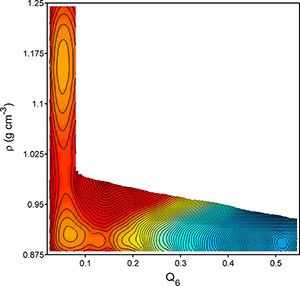
Princeton University researchers conducted computer simulations to explore what happens to water as it is cooled to temperatures below freezing and found that the supercooled liquid separated into two liquids with different densities. The finding agrees with a two-decade-old hypothesis to explain water’s peculiar behaviors, such as becoming more compressible and less dense as it is cooled. The X axis above indicates the range of crystallinity (Q6) from liquid water (less than 0.1) to ice (greater than 0.5) plotted against density (ρ) on the Y axis. The figure is a two-dimensional projection of water’s calculated "free energy surface," a measure of the relative stability of different phases, with orange indicating high free energy and blue indicating low free energy. The two large circles in the orange region reveal a high-density liquid at 1.15 g/cm3 and low-density liquid at 0.90 g/cm3. The blue area represents cubic ice, which in this model forms at a density of about 0.88 g/cm3. (Image courtesy of Jeremy Palmer)
Familiar yet strange: Water's 'split personality' revealed by computer model. Posted June 18, 2014; 01:00 p.m. by Catherine Zandonella, Office of the Dean for Research Seemingly ordinary, water has quite puzzling behavior. Why, for example, does ice float when most liquids crystallize into dense solids that sink? Using a computer model to explore water as it freezes, a team at Princeton University has found that water's weird behaviors may arise from a sort of split personality: at very cold temperatures and above a certain pressure, water may spontaneously split into two liquid forms. The team's "Our results suggest that at low enough temperatures water can coexist as two different liquid phases of different densities," said Pablo Debenedetti , the Class of 1950 Professor in Engineering and Applied Science and Princeton's dean for research , and a professor of chemical and biological engineering. The two forms coexist a bit like oil and vinegar in salad dressing, except that the water separates from itself rather than from a different liquid. "Some of the molecules want to go into one phase and some of them want to go into the other phase," said Jeremy Palmer, a postdoctoral researcher in the Debenedetti lab. The finding that water has this dual nature, if it can be replicated in experiments, could lead to better understanding of how water behaves at the cold temperatures found in high-altitude clouds where liquid water can exist below the freezing point in a "supercooled" state before forming hail or snow, Debenedetti said.
TO READ THIS ARTICLE, CREATE YOUR ACCOUNT
And extend your reading, free of charge and with no commitment.