Davis Lab
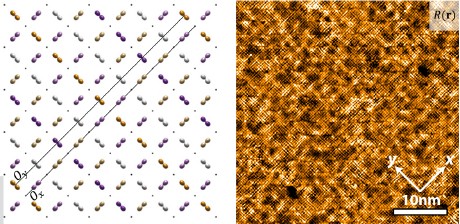
A team at Cornell and Brookhaven National Laboratory has discovered that previously observed density waves that seem to suppress superconductivity are linked to an electronic "broken symmetry," offering an important clue to why superconductivity doesn't happen at higher temperatures. "This exotic state has been predicted for decades," said J.C. Séamus Davis, the James Gilbert White Distinguished Professor in the Physical Sciences at Cornell and director of the Center for Emergent Superconductivity at Brookhaven National Laboratory. "It is a pattern of electronic structure in a crystal that has never been seen experimentally before." The results were reported July 2 online in the Proceedings of the National Academy of Sciences. Superconductivity, where an electric current moves with zero resistance, is seen in metals cooled almost to absolute zero (-273.15 degrees Celsius or -459. Fahrenheit). Newly discovered materials superconduct at temperatures up to around 150 degrees C above absolute zero. Moving that temperature higher - even up to room temperature - could lead to a revolution in motors, generators and power transmission.
TO READ THIS ARTICLE, CREATE YOUR ACCOUNT
And extend your reading, free of charge and with no commitment.