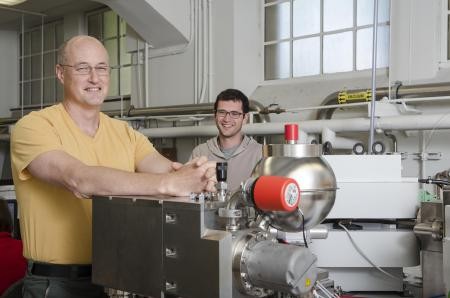
John Eiler (left) and Daniel Stolper (right) with the Caltech-led team's prototype mass spectrometer--the Thermo IRMS 253 Ultra. This machine enabled the first precise measurements of molecules of methane that contain two heavy isotopes--13CH3D, which incorporates both a carbon-13 atom and a deuterium atom, and 12CH2D2, which includes two deuterium atoms.
Methane is a simple molecule consisting of just one carbon atom bound to four hydrogen atoms. But that simplicity belies the complex role the molecule plays on Earth-it is an important greenhouse gas, is chemically active in the atmosphere, is used in many ecosystems as a kind of metabolic currency, and is the main component of natural gas, which is an energy source. Methane also poses a complex scientific challenge: it forms through a number of different biological and nonbiological processes under a wide range of conditions. For example, microbes that live in cows' stomachs make it; it forms by thermal breakdown of buried organic matter; and it is released by hot hydrothermal vents on the sea floor. And, unlike many other, more structurally complex molecules, simply knowing its chemical formula does not necessarily reveal how it formed. Therefore, it can be difficult to know where a sample of methane actually came from. But now a team of scientists led by Caltech geochemist John M. Eiler has developed a new technique that can, for the first time, determine the temperature at which a natural methane sample formed.
TO READ THIS ARTICLE, CREATE YOUR ACCOUNT
And extend your reading, free of charge and with no commitment.