Wiesner group
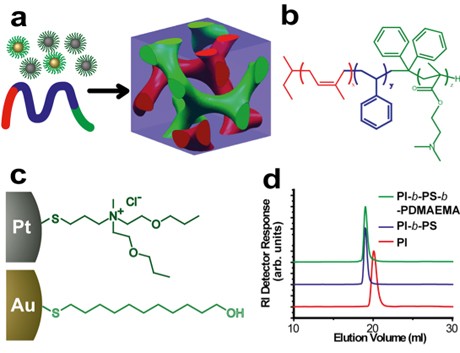
Transmission electron microscopy shows metal nanoparticle networks following the removal of the copolymer that acted as a structural scaffold for the particles. Electron tomography reconstruction of platinum nanoparticles (red) in network structures, compared with self-consistent field theory results (blue). For close to two decades, Cornell scientists have developed processes for using polymers to self-assemble inorganic nanoparticles into porous structures that could revolutionize electronics, energy and more. This process has now been driven to an unprecedented level of precision using metal nanoparticles, and is supported by rigorous analysis of the theoretical details behind why and how these particles assemble with polymers. Such a deep understanding of the complex interplay between the chemistry and physics that drive complex self-assembly paves the way for these new materials to enter many applications, from electrocatalysis in fuel cells to voltage conductance in circuits. Ulrich Wiesner, the Spencer T. Olin Professor of Materials Science and Engineering, led what is probably the most comprehensive study to date of block copolymer nanoparticle self-assembly processes. The study was published online Feb.
TO READ THIS ARTICLE, CREATE YOUR ACCOUNT
And extend your reading, free of charge and with no commitment.