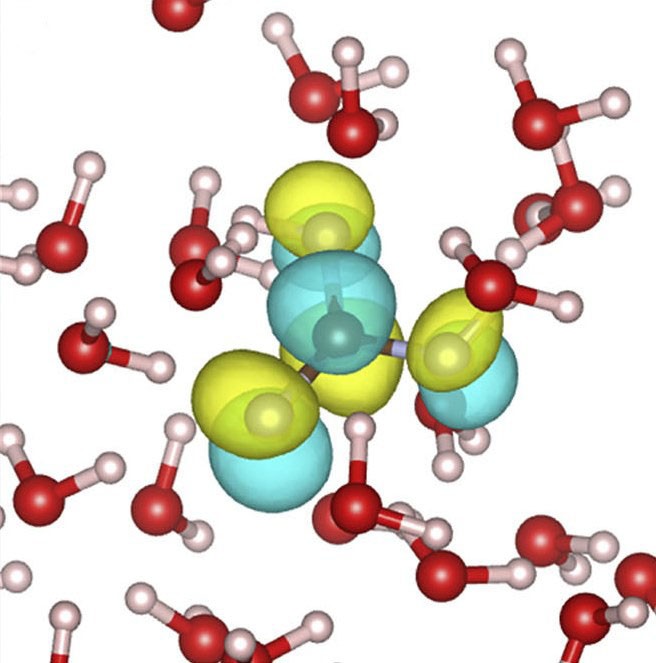
Though carbonic acid exists for only a fraction of a second before changing into a mix of hydrogen and bicarbonate ions, it is critical to both the health of the atmosphere and the human body.
Though it garners few public headlines, carbonic acid, the hydrated form of carbon dioxide, is critical to both the health of the atmosphere and the human body. However, because it exists for only a fraction of a second before changing into a mix of hydrogen and bicarbonate ions, carbonic acid has remained an enigma. A new study by Berkeley Lab researchers has yielded valuable new information about carbonic acid with important implications for both geological and biological concerns. Richard Saykally, a chemist with Berkeley Lab's Chemical Sciences Division and a professor of chemistry at the University of California (UC) Berkeley, led a study that produced the first X-ray absorption spectroscopy (XAS) measurements for aqueous carbonic acid. These XAS measurements, which were obtained at Berkeley Lab's Advanced Light Source (ALS), were in strong agreement with supercomputer predictions obtained at the National Energy Research Scientific Computing Center (NERSC). The combination of theoretical and experimental results provides new and detailed insights into the hydration properties of aqueous carbonic acid that should benefit the development of carbon sequestration and mitigation technologies, and improve our understanding of how carbonic acid regulates the pH of blood. "Our results support an average hydration number of 3.17 with the acid's two protons each donating a strong hydrogen bond to solvating waters, the carbonyl oxygen accepting a strong hydrogen bond from solvating water, and the hydroxyl oxygen molecules accepting weak hydrogen bonds from the water," says Saykally.
TO READ THIS ARTICLE, CREATE YOUR ACCOUNT
And extend your reading, free of charge and with no commitment.