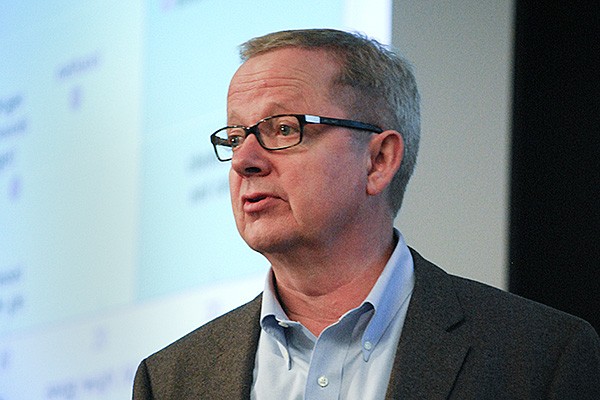
Jens Nørskov and colleagues at Stanford, SLAC and the Danish Technical University have discovered a new catalyst that could lead to the low-cost production of clean methanol.
Scientists from Stanford, SLAC and Denmark have created a new nickel-gallium catalyst that could some day be used to convert hydrogen and carbon dioxide emissions into methanol, an important industrial chemical and potential fuel. An international research team has discovered a potentially clean, low-cost way to convert carbon dioxide into methanol, a key ingredient in the production of plastics, adhesives and solvents, and a promising fuel for transportation. Scientists from Stanford University, SLAC National Accelerator Laboratory and the Technical University of Denmark combined theory and experimentation to identify a new nickel-gallium catalyst that converts hydrogen and carbon dioxide into methanol with fewer side-products than the conventional catalyst. The results are published in the March 2 online edition of . "Methanol is processed in huge factories at very high pressures using hydrogen, carbon dioxide and carbon monoxide from natural gas," said study lead author Felix Studt, a staff scientist at SLAC. "We are looking for materials than can make methanol from clean sources, such as sunshine, under low-pressure conditions, while generating low amounts of carbon monoxide." The ultimate goal is to develop a large-scale manufacturing process that is nonpolluting and carbon neutral using clean hydrogen, the authors said. "Imagine if you could synthesize methanol using hydrogen from renewable sources, such as water split by sunlight, and carbon dioxide captured from power plants and other industrial smokestacks," said co-author Jens Nørskov , a professor of chemical engineering at Stanford.
TO READ THIS ARTICLE, CREATE YOUR ACCOUNT
And extend your reading, free of charge and with no commitment.