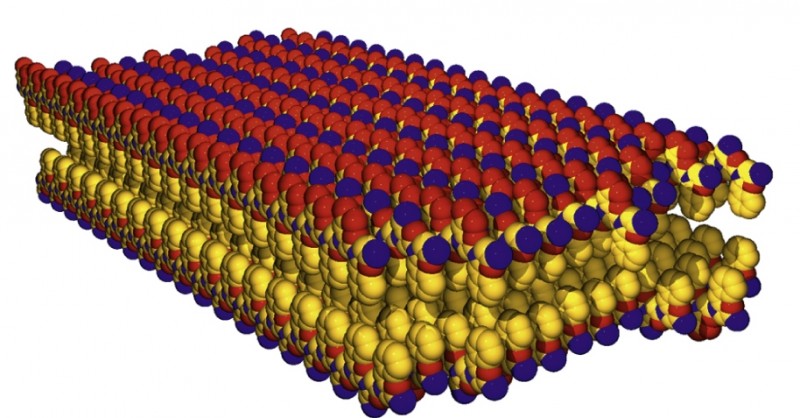
Peptoid nanosheets are among the largest and thinnest free-floating organic crystals ever made, with an area-to-thickness equivalent of a plastic sheet covering a football field. Peptoid nanosheets can be engineered to carry out a wide variety of functions.
From the people who brought us peptoid nanosheets that form at the interface between air and water, now come peptoid nanosheets that form at the interface between oil and water. Scientists at the U.S. Department of Energy (DOE)'s Lawrence Berkeley National Laboratory (Berkeley Lab) have developed peptoid nanosheets - two-dimensional biomimetic materials with customizable properties - that self-assemble at an oil-water interface. This new development opens the door to designing peptoid nanosheets of increasing structural complexity and chemical functionality for a broad range of applications, including improved chemical sensors and separators, and safer, more effective drug delivery vehicles. "Supramolecular assembly at an oil-water interface is an effective way to produce 2D nanomaterials from peptoids because that interface helps pre-organize the peptoid chains to facilitate their self-interaction," says Ron Zuckermann, a senior scientist at the Molecular Foundry, a DOE nanoscience center hosted at Berkeley Lab. "This increased understanding of the peptoid assembly mechanism should enable us to scale-up to produce large quantities, or scaledown to screen many different nanosheets for novel functions." Zuckermann, who directs the Molecular Foundry's Biological Nanostructures Facility, and Geraldine Richmond of the University of Oregon are the corresponding authors of a paper reporting these results in the Proceedings of the National Academy of Sciences (PNAS).
TO READ THIS ARTICLE, CREATE YOUR ACCOUNT
And extend your reading, free of charge and with no commitment.