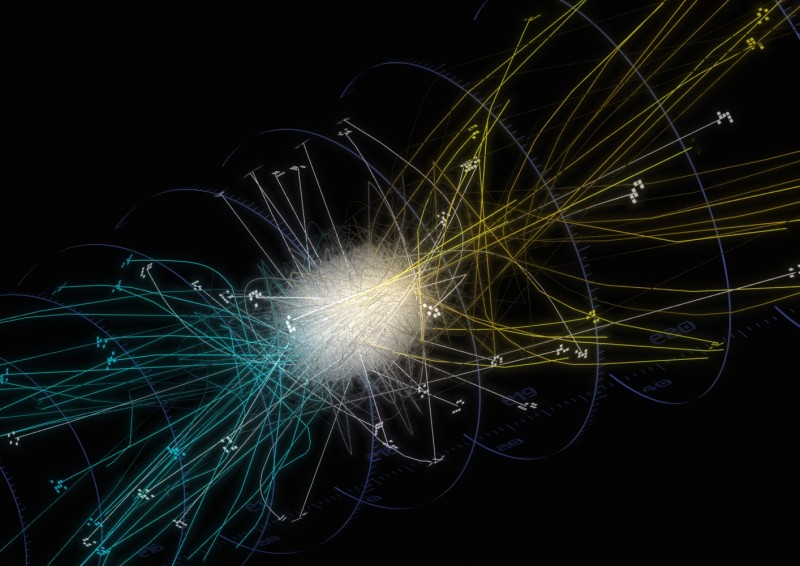
Trajectories of antihydrogen atoms released from the ALPHA trap. The dots represent where the anti-atoms annihilate on the trap wall; under the influence of an electric field, the different charges, which are all very close to zero, segregate to different areas of the trap. Chukman So, Berkeley
Hydrogen is a neutral atom. Its single electron orbits a single proton, and the net effect is no electrical charge. But what about hydrogen's antimatter counterpart, antihydrogen? Made of a positron that orbits an antiproton, the antihydrogen atom should be neutral too. Various results have indicated as much, but because the charge of antiatoms is difficult to measure, it has remained an open question. A recent experiment to measure the charge of antihydrogen has now placed a bound on the atom's charge. Physicists from Berkeley Lab, the University of California, and other institutions part of the ALPHA collaboration at CERN, have published a new measurement of the charge of antihydrogen, determined with unprecedented precision. The result: effectively zero.
TO READ THIS ARTICLE, CREATE YOUR ACCOUNT
And extend your reading, free of charge and with no commitment.