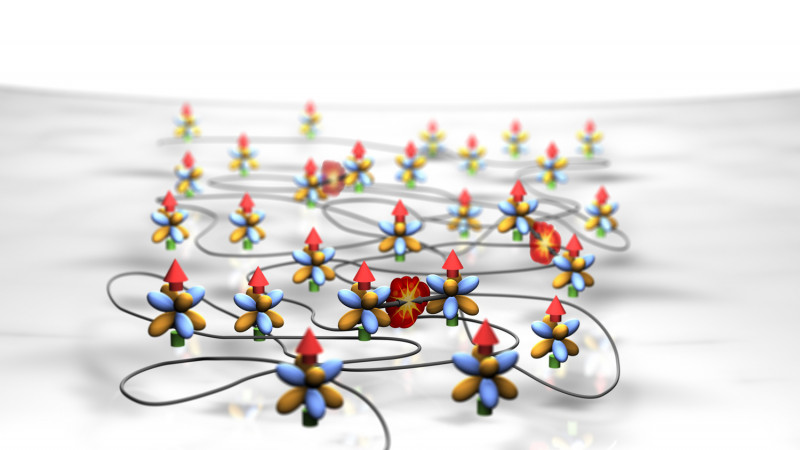
Caption: Even simple systems, such as neutral atoms, can possess chaotic behavior. Photo credit: Erbium Team, University of Innsbruck
The team of Francesca Ferlaino, University of Innsbruck, discovered that even simple systems, such as neutral atoms, can possess chaotic behavior, which can be revealed using the tools of quantum mechanics. The ground-breaking research opens up new avenues to observe the interaction between quantum particles. The team of Francesca Ferlaino, Institute for Experimental Physics of the University of Innsbruck, Austria, has experimentally shown chaotic behavior of particles in a quantum gas. "For the first time we have been able to observe quantum chaos in the scattering behavior of ultracold atoms," says an excited Ferlaino. The physicists used random matrix theory to confirm their results, thus asserting the universal character of this statistical theory. Nobel laureate Eugene Wigner formulated random matrix theory to describe complex systems in the 1950s. Although interactions between neutrons with atomic nuclei were not well-known then, Wigner was able to reliably predict properties of complex spectra by using random matrices.
TO READ THIS ARTICLE, CREATE YOUR ACCOUNT
And extend your reading, free of charge and with no commitment.