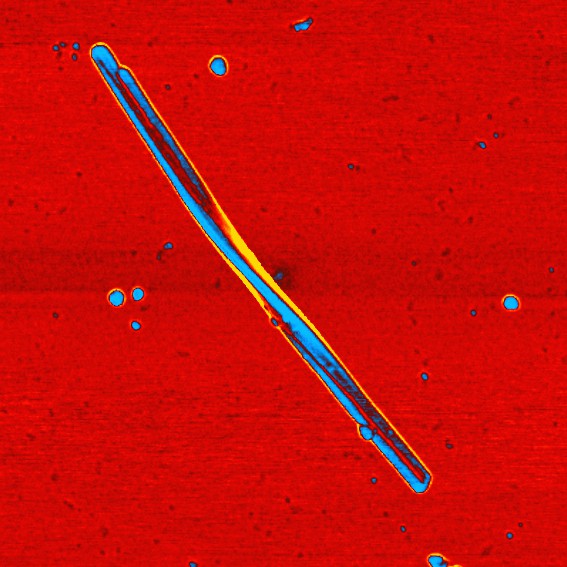
A twisted ribbon of cadmium telluride nanoparticles. University of Michigan engineering researchers have discovered that circularly polarized light can affect the chirality, or handedness, of nanoparticle chains. Their findings could provide insights into the structure of life. Image credit: Jihyeon Yeom
ANN ARBOR-As hands come in left and right versions that are mirror images of each other, so do the amino acids and sugars within us. But unlike hands, only the left-oriented amino acids and the right-oriented sugars ever make into life as we know it. Scientists know the other varieties exist because when they synthesize these amino acids and sugars in a lab, roughly equal numbers of leftand right-facing arrangements form. But life prefers one. It's a mysterious phenomenon called "homochirality." Scientists have several theories as to why it occurs. In findings that underscore the role that light may have played in its origin on Earth, a team led by a University of Michigan researcher has shown that the rotational direction of a light beam can coax inorganic nanoparticles to assemble themselves into what amount to leftor right-handed twisting ribbons. Left-handed ribbons twist counterclockwise, and right-handed clockwise.
TO READ THIS ARTICLE, CREATE YOUR ACCOUNT
And extend your reading, free of charge and with no commitment.