Yuefeng Nie
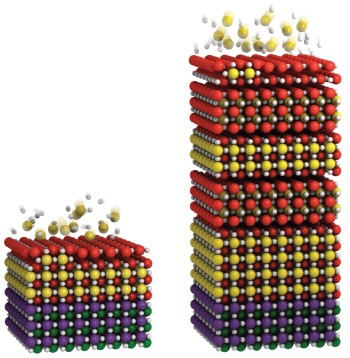
Like the perfect sandwich, a perfectly engineered thin film for electronics requires not only the right ingredients, but also just the right thickness of each ingredient in the desired order, down to individual layers of atoms. Cornell researchers have discovered that sometimes, layer-by-layer atomic assembly - a powerful technology capable of making new materials for electronics - requires some unconventional "sandwich making" techniques. The team, led by thin-films expert Darrell Schlom, the Herbert Fisk Johnson Professor of Industrial Chemistry in the Department of Materials Science and Engineering, describes the trick of growing perfect films of oxides called Ruddlesden-Poppers Aug. These oxides are widely studied for their electronically enticing properties, among them superconductivity, magnetoresistance and ferromagnetism. Their layered structure is like a double Big Mac with alternating double and single layers of meat patties - strontium oxide - and bread - titanium oxide - in the case of the Ruddlesden-Poppers studied. "Our dream is to control these materials with atomic precision," Schlom said. "We think that controlling interfaces between Ruddlesden-Poppers will lead to exotic and potentially useful, emergent properties." Schlom's lab makes novel thin films with molecular beam epitaxy, a deposition method that controls the order in which atom-thick layers are assembled layer-by-layer, which Schlom likens to precision spray-painting with atoms.
TO READ THIS ARTICLE, CREATE YOUR ACCOUNT
And extend your reading, free of charge and with no commitment.