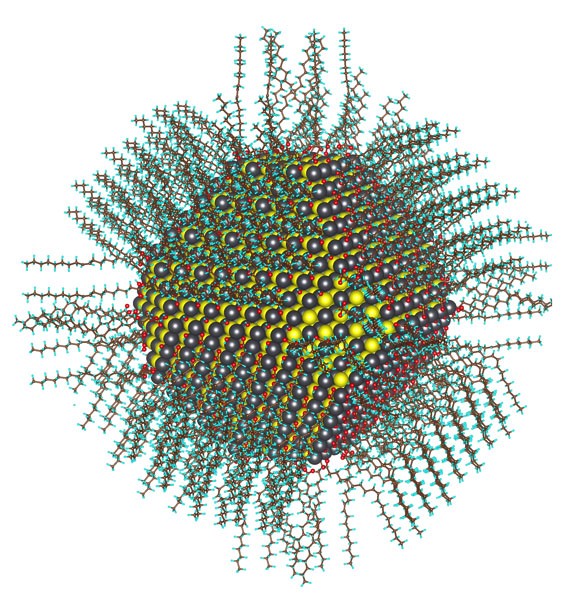
Calculated atomic structure of a 5nm diameter nanocrystal passivated with oleate and hydroxyl ligands.
Danylo Zherebetskyy and his colleagues at the U.S. Department of Energy's Lawrence Berkeley National Laboratory (Berkeley Lab) found unexpected traces of water in semiconducting nanocrystals. The water as a source of small ions for the surface of colloidal lead sulfide (PbS) nanoparticles allowed the team to explain just how the surface of these important particles are passivated, meaning how they achieve an overall balance of positive and negative ions. This has been a big question for some fifteen years, and the answer washes up in hydroxyl groups from water that had been thought not to be there. "Passivation is required mostly in colloidal solutions, which is the cheap way to produce nanoparticles. Imagine the surface of the nanostructure: there are ligands, also called surfactants, binding to the surface," explains Zherebetskyy. "The surfactants define a lot of the chemical and physical properties of the nanoparticles." "We can synthesize a very beautiful nanostructure, and know how to control even the shape. But how to control the shape is related to how you passivate a surface during the growth process, and exactly how ligands passivate the surface [and how electronic structures happen] has never been well understood," adds Lin-Wang Wang, senior staff scientist at Berkeley Lab and leader of Berkeley Lab's Computational Material Science and Nano Science Group.
TO READ THIS ARTICLE, CREATE YOUR ACCOUNT
And extend your reading, free of charge and with no commitment.