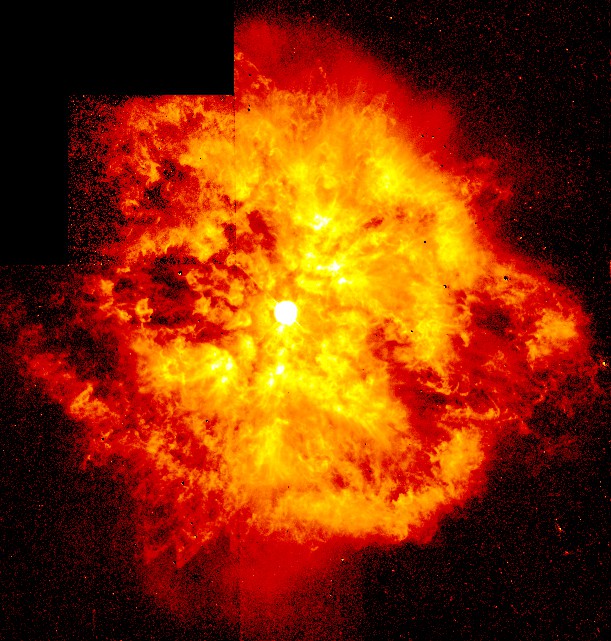
Composite image of an energetic star explosion taken by the Hubble Space Telescope in March of 1997. Credit: NASA
Researchers from Berkeley Lab & University of Hawaii at Manoa map the first chemical bonds that eventually give rise to DNA. DNA is synonymous with life, but where did it originate? One way to answer this question is to try to recreate the conditions that formed DNA's molecular precursors. These precursors are carbon ring structures with embedded nitrogen atoms, key components of nucleobases, which themselves are building blocks of the double helix. Now, researchers from the U.S. Department of Energy's Lawrence Berkeley National Lab (Berkeley Lab) and the University of Hawaii at Manoa have shown for the first time that cosmic hot spots, such as those near stars, could be excellent environments for the creation of these nitrogen-containing molecular rings. In a new paper in the Astrophysical Journal, the team describes the experiment in which they recreate conditions around carbon-rich, dying stars to find formation pathways of the important molecules. "This is the first time anyone's looked at a hot reaction like this," says Musahid Ahmed, scientist in the Chemical Sciences Division at Berkeley Lab. It's not easy for carbon atoms to form rings that contain nitrogen, he says.
TO READ THIS ARTICLE, CREATE YOUR ACCOUNT
And extend your reading, free of charge and with no commitment.