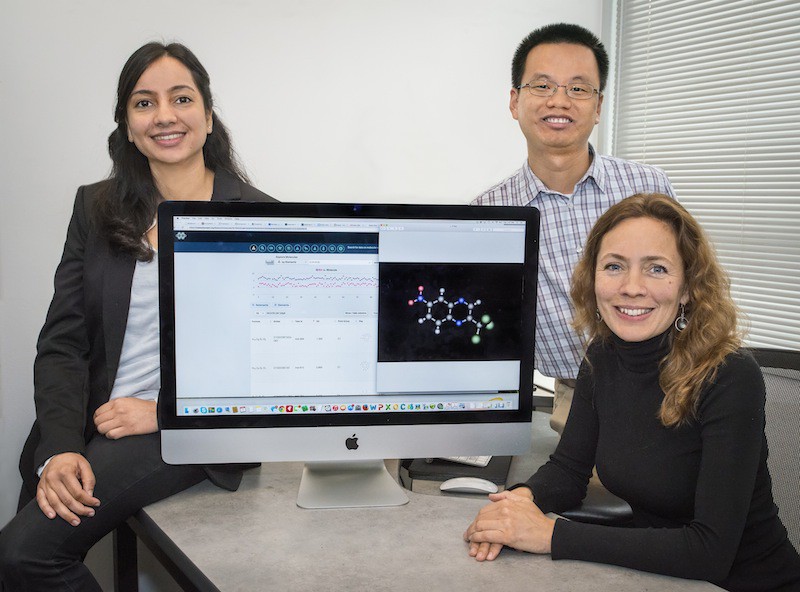
Berkeley Lab scientist Kristin Persson (right) and her Electrolyte Genome team, Nav Nidhi Rajput and Xiaohui Qu. (Photo by Roy Kaltschmidt/Berkeley Lab)
A new breakthrough battery-one that has significantly higher energy, lasts longer, and is cheaper and safer-will likely be impossible without a new material discovery. And a new material discovery could take years, if not decades, since trial and error has been the best available approach. But Lawrence Berkeley National Laboratory (Berkeley Lab) scientist Kristin Persson says she can take some of the guesswork out of the discovery process with her Electrolyte Genome. Think of it as a Google-like database of molecules. A battery scientist looking for a new electrolyte would specify the desired parameters and properties, and the Electrolyte Genome would return a short list of promising candidate molecules, dramatically speeding up the discovery timeline. "Electrolytes are a stumbling block for many battery technologies, whether the platform is designed for electric vehicles or a flow battery for grid applications," Persson said. "What we can do is calculate the properties of a large number of molecules and give experimentalists a much better set of materials to work with than if they were to explore all possible combinations." The electrolyte is a chemical substance that carries electrical charge between the battery's anode and cathode to charge and discharge the cell.
TO READ THIS ARTICLE, CREATE YOUR ACCOUNT
And extend your reading, free of charge and with no commitment.