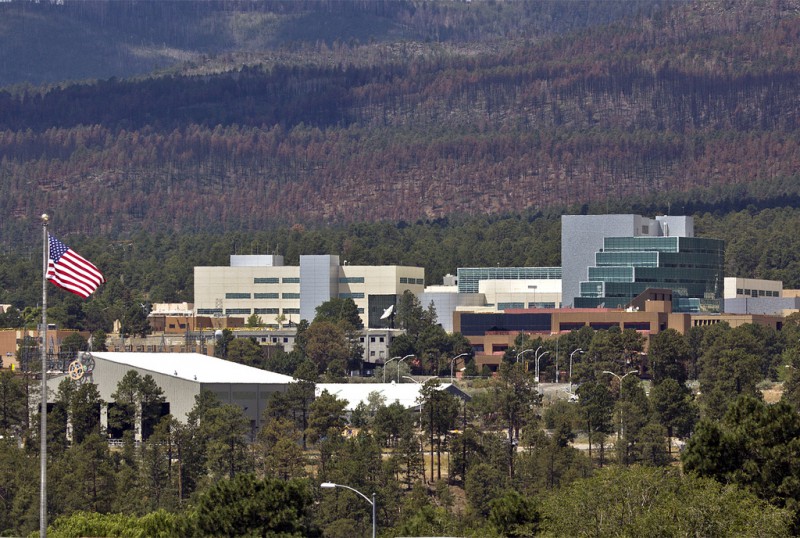
Los Alamos National Laboratory sits on top of a once-remote mesa in northern New Mexico with the Jemez mountains as a backdrop to research and innovation covering multi-disciplines from bioscience, sustainable energy sources, to plasma physics and new materials.
"Remarkable progress in cooling and trapping molecules in recent years has opened up an entirely new energy regime for studying chemical reactivity at temperatures below one micro-Kelvin," said Brian Kendrick. Discovery has important technological applications LOS ALAMOS, N.M. July 31, 2015-Researchers have discovered a new interference mechanism in ultracold chemical reactions, one which has important technological applications in precision measurements, sensing and quantum computing. "Remarkable progress in cooling and trapping molecules in recent years has opened up an entirely new energy regime for studying chemical reactivity at temperatures below one micro-Kelvin,” said Brian Kendrick, of the Los Alamos National Laboratory's Theoretical Division. "Ultracold chemistry exhibits unique quantum properties, which provides a switch for effectively turning the reaction on or off." Chemical reactions at ultracold temperatures have unique (quantum) properties that do not occur at normal room temperatures, causing the ultracold chemical reaction rates to be comparable to or even larger than they are at room temperature. The discovery of a new mechanism for controlling ultracold chemical reactions is based on the interference between two reaction pathways, which contribute to the total chemical reaction rate. The pathways add up or interfere with each other, either constructively or destructively. At ultracold temperatures, the interference between these pathways becomes dramatically enhanced, reaching the maximum or minimum possible values allowed.
TO READ THIS ARTICLE, CREATE YOUR ACCOUNT
And extend your reading, free of charge and with no commitment.