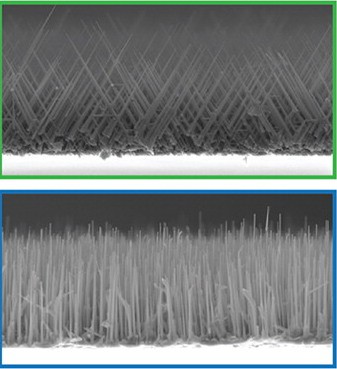
Nanowires grown using catalyst rich in gold (top) and nickel (bottom). Credit: Berkeley Lab
A novel approach to growing nanowires promises a new means of control over their light-emitting and electronic properties. In a recent issue of Nano Letters , scientists from the U.S. Department of Energy's Lawrence Berkeley National Lab (Berkeley Lab) demonstrated a new growth technique that uses specially engineered catalysts. These catalysts, which are precursors to growing the nanowires, have given scientists more options than ever in turning the color of light-emitting nanowires. The new approach could potentially be applied to a variety of materials and be used for making next-generation devices such as solar cells, light emitting diodes, high power electronics and more, says Shaul Aloni, staff scientist at Berkeley Lab's Molecular Foundry, a DOE user facility, and lead author on the study. Since the early 2000s, scientists have made steady progress in cultivating nanowires. Initially, early nanowire samples resembled "tangled noodles or wildfire-ravaged forests," according to the researchers. More recently, scientists have found various conditions lead to the growth of more orderly nanowire arrays.
TO READ THIS ARTICLE, CREATE YOUR ACCOUNT
And extend your reading, free of charge and with no commitment.