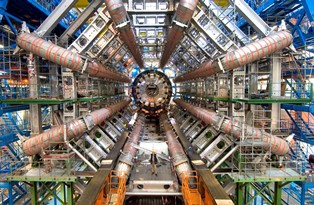
ATLAS detector - credit CERN
We use cookies to ensure that we give you the best experience on our website. You can change your cookie settings at any time. Otherwise, we'll assume you're OK to continue. Restart of the Large Hadron Collider could lead to "new discoveries” The restart of the Large Hadron Collider (LHC) could lead to "fundamental breakthroughs" in our understanding of the Universe, according to a Durham University expert. The LHC particle accelerator was restarted at the weekend after a shut-down lasting two years (Sunday April 5). The LHC will be running at almost double the energy of Run One when scientists announced they had discovered the Higgs boson.The Higgs generates masses for other elementary particles via the Higgs mechanism and without it the Universe would not remotely look like anything we see today. During its second three-year run, scientists hope the LHC, based at CERN in Geneva, will open a new window for potential discovery, allowing further studies on the Higgs boson and potentially addressing unsolved mysteries such as dark matter.
TO READ THIS ARTICLE, CREATE YOUR ACCOUNT
And extend your reading, free of charge and with no commitment.