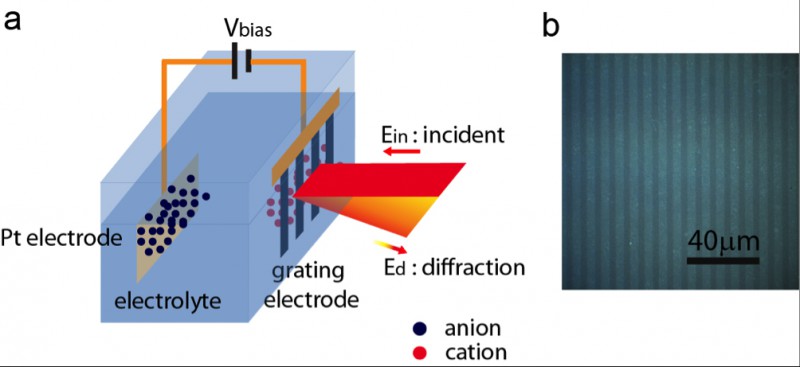
Schematic illustration of the spectroscopy design with graphene grating: a)Electrochemical cell and spectroscopy configuration (Pt = Platinum); b) Optical microscopic image of a graphene grating on fused silica. Credit: Feng Wang, Berkeley Lab
Berkeley Lab researchers' novel diffraction spectroscopy technique will provide insight to chemical processes at important battery interface. One of the most important things to understand in battery technology is the precise physical and chemical processes that occur at the electrode/electrolyte interface. However, microscopic understanding of these processes is quite limited due to a lack of suitable probing techniques. Now, researchers at the US Department of Energy's (DOE) Lawrence Berkeley National Laboratory (Berkeley Lab) and the University of California, Berkeley, have developed a new technique that enables sensitive and specific detection of molecules at the electrode/electrolyte interface. This new method uses diffraction from graphene gratings to overcome key difficulties associated with traditional optical spectroscopy that employs infrared probing of buried interfaces. "Most of the electrical chemical reaction in a battery happens at the electrolyte/electrode interface, and it is important to know how tuning the electrode voltage induces field-dependent chemical processes. This requires distinction between microscopic molecule behavior at the interface, such as physical absorption, and electrochemical reaction from the bulky electrolyte solution," says Feng Wang, a physicist at Berkeley Lab's Materials Sciences Division and a member of the Kavli Energy NanoSciences Institute at Berkeley, who led this work.
TO READ THIS ARTICLE, CREATE YOUR ACCOUNT
And extend your reading, free of charge and with no commitment.