Supersonic electrons could produce future solar fuel
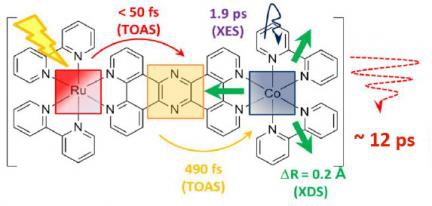
Researchers from institutions including Lund University have taken a step closer to producing solar fuel using artificial photosynthesis. In a new study, they have successfully tracked the electrons' rapid transit through a light-converting molecule. The ultimate aim of the present study is to find a way to make fuel from water using sunlight. This is what photosynthesis does all the time - plants convert water and carbon dioxide to energy rich molecules using sunlight. Researchers around the world are therefore attempting to borrow ideas from photosynthesis in order to find a way to produce solar fuel artificially. "Our study shows how it is possible to construct a molecule in which the conversion of light to chemical energy happens so fast that no energy is lost as heat. This means that all the energy in the light is stored in a molecule as chemical energy", said Villy Sundström, Professor of Chemical Physics at Lund University.
TO READ THIS ARTICLE, CREATE YOUR ACCOUNT
And extend your reading, free of charge and with no commitment.