Der Tanz der Atome
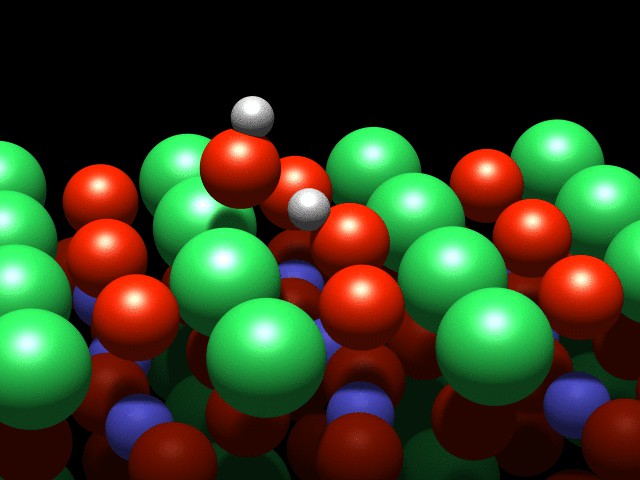
Pole dancing water molecules - Researchers at the TU Wien have seen this remarkable phenomenon on the surface of an important technological material. Perovskites are materials used in batteries, fuel cells, and electronic components, and occur in nature as minerals. Despite their important role in technology, little is known about the reactivity of their surfaces. Professor Ulrike Diebold's team at TU Wien (Vienna) has answered a long-standing question using scanning tunnelling microscopes and computer simulations: How do water molecules behave when they attach to a perovskite surface? Normally only the outermost atoms at the surface influence this behaviour, but on perovskites the deeper layers are important, too. Perovskite dissociates water molecules - "We studied strontium ruthenate - a typical perovskite material," says Ulrike Diebold. It has a crystalline structure containing oxygen, strontium and ruthenium. When the crystal is broken apart, the outermost layer consists of only strontium and oxygen atoms; the ruthenium is located underneath, surrounded by oxygen atoms.
TO READ THIS ARTICLE, CREATE YOUR ACCOUNT
And extend your reading, free of charge and with no commitment.