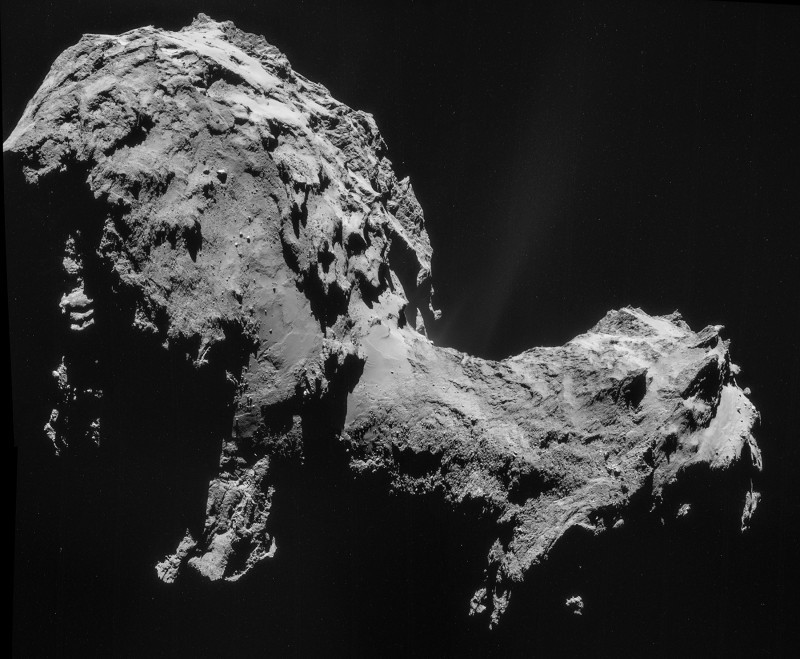
"Portrait" of Comet 67P/Churyumov-Gerasimenko in September 2014, taken with Rosetta’s camera system when the space probe was 28 km from the comet and the mass spectrometer ROSINA was collecting data. ESA/Rosetta/NAVCAM
The biggest surprise so far in the chemical analysis of Comet Churyumov-Gerasimenko's atmosphere is the high proportion of oxygen molecules. While such molecules are common in the earth's atmosphere, their presence on comets had originally been ruled out. Early on in the mission of the ROSINA mass spectrometer, in September of last year, researchers from the Center for Space and Habitability (CSH) at the University of Bern made an unexpected discovery when analyzing the comet's gases: Between the expected peak values of sulfur and methanol, clear traces of oxygen (O2) molecules were detected. It turned out that O2 is in fact the fourth most common gas in the comet's atmosphere, after water (H2O), carbon monoxide (CO) and carbon dioxide (CO2). As oxygen is highly reactive chemically, it was previously thought that in the early solar system it must have combined with the abundant hydrogen then present to form water. Nevertheless, oxygen molecules were present on the comet. "We had never thought that oxygen could 'survive' for billions of years without combining with other substances," says Prof. Kathrin Altwegg, project leader of the ROSINA mass spectrometer and co-author of the study.
TO READ THIS ARTICLE, CREATE YOUR ACCOUNT
And extend your reading, free of charge and with no commitment.