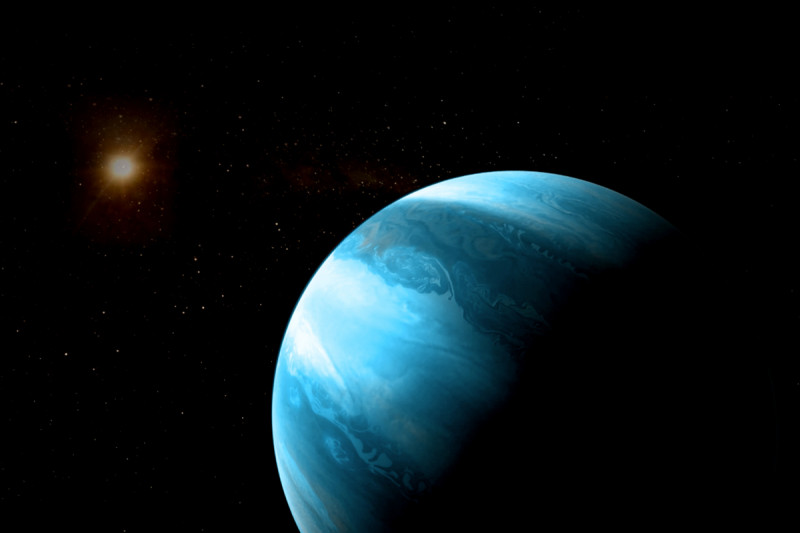
 Artist’s impression of a jupiter-like planet with a blueish colour orbiting a cool red dwarf.
Astronomers detected a giant planet orbiting a small star. The planet has much more mass than theoretical models predict. While this surprising discovery was made by a Spanish-German team at an observatory in southern Spain, researchers at the University of Bern studied how the mysterious exoplanet might have formed. The red dwarf GJ 3512 is located 30 light-years from us. Although the star is only about a tenth of the mass of the Sun, it possesses a giant planet - an unexpected observation. "Around such stars there should only be planets the size of the Earth or somewhat more massive Super-Earths," says Christoph Mordasini, professor at the University of Bern and member of the National Centre of Competence in Research (NCCR) PlanetS: "GJ 3512b, however, is a giant planet with a mass about half as big as the one of Jupiter, and thus at least one order of magnitude more massive than the planets predicted by theoretical models for such small stars." The mysterious planet was detected by a Spanish-German research consortium called CARMENES, which has set itself the goal of discovering planets around the smallest stars. For this purpose, the consortium built a new instrument, which was installed at the Calar Alto Observatory at 2100 m altitude in southern Spain.
TO READ THIS ARTICLE, CREATE YOUR ACCOUNT
And extend your reading, free of charge and with no commitment.
Your Benefits
- Access to all content
- Receive newsmails for news and jobs
- Post ads