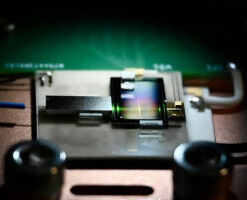
New holographic technique opens the way for quantum computation
EPFL physicists have developed a method based on the principles of holograms to capture 3D images of objects beyond the reach of light. Photography measures how much light of different color hits the photographic film. However, light is also a wave, and is therefore characterized by the phase. Phase specifies the position of a point within the wave cycle and correlates to depth of information, meaning that recording the phase of light scattered by an object can retrieve its full 3D shape, which cannot be obtained with a simple photograph. This is the basis of optical holography, popularized by fancy holograms in sci-fi movies like Star Wars. But the problem is that the spatial resolution of the photo/hologram is limited by the wavelength of light, around or just-below 1 'm (0.001 mm). That's fine for macroscopic objects, but it starts to fail when entering the realm of nanotechnology.