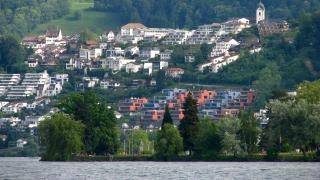
The town of Wollerau, Canton Schwyz, which lies on the upper Zürichsee ( Wikimedia)
How do local tax havens emerge? Is tax competition harmful? Raphaël Parchet, Assistant professor at the Faculty of Economics of Università della Svizzera italiana, addresses these questions in his new project "Sorting, Tax Competition and the Rise of Local Tax Havens", funded by the Swiss National Science Foundation (SNSF), shedding new light on the logic behind the rise of tax havens in Switzerland. The emergence of tax havens Professor Parchet has been devoting much of his research to the topic of tax competition, paying particular attention to Swiss municipalities. His new research project, which received a 3-year funding from the SNSF, will now focus on the increasingly hotly debated topic of the emergence of tax havens. The project builds on one of Parchet's recent articles, " Culture and Taxes " (published in the Journal of Political Economy , jointly written with Beatrix Eugster from the University of St. Gallen). "Casual empirical evidence of Swiss municipalities suggests that some places indeed emerge as tax havens with (very) low tax rates, a high concentration of top-income taxpayers and high housing prices", explains Professor Parchet. Other typical elements that characterize a tax haven are, as anecdotal evidence indicates, rather small dimensions, the presence of high amenities - as for example the access to a lake - and a good connection to a nearby major urban centre. Wollerau, a municipality in the Canton of Schwyz, could represent a good and fitting example of this initial hypothesis: located on the shores of Lake Zurich, well connected to the City of Zurich, Wollerau attracts wealthy taxpayers and has one of the lowest tax rates in the area.
TO READ THIS ARTICLE, CREATE YOUR ACCOUNT
And extend your reading, free of charge and with no commitment.