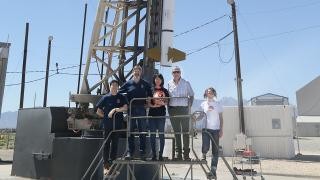
Some of the CLASP-II scientists pose for a photograph in front of the rocket at White Sands Missile Range (New Mexico, USA) ( U.S. Army, Louis Rosales)
Some of the CLASP-II scientists pose for a photograph in front of the rocket at White Sands Missile Range (New Mexico, USA) (image: U.S. Army, Louis Rosales) On April 11, 2019, at the NASA facility at the White Sands Missile Range in New Mexico (USA), the successful launch of a sounding rocket was performed as part of the "Chromospheric LAyer Spectro-Polarimeter" experiment (CLASP-II). The experiment also involved the the Istituto Ricerche Solari Locarno (IRSOL, associated with USI) in the theoretical interpretation of the data. This activity requires also the application of sophisticated computational methods, for the development of which IRSOL collaborates closely with the Institute of Computational Sciences (ICS) at the USI Faculty of Informatics. CLASP-II is an international collaboration led by NASA's Marshall Space Flight Center (USA), the National Astronomical Observatory of Japan (NAOJ, Tokyo, Japan), the Instituto de Astrofísica de Canarias (IAC, Tenerife, Spain) and the Institut d'Astrophysique Spatiale (IAS, Orsay, France). Additional partners are the Astronomical Institute of the Academy of Sciences of the Czech Republic (ASCR), the Istituto Ricerche Solari Locarno (IRSOL, Switzerland), Lockheed Martin Solar & Astrophysics Laboratory (Palo Alto, USA), Stockholm University (Sweden), and the Rosseland Center for Solar Physics Research (Oslo, Norway). The goal of CLASP-II was to provide new spectro-polarimetric observations of a particular layer of the solar atmosphere, the chromosphere.
TO READ THIS ARTICLE, CREATE YOUR ACCOUNT
And extend your reading, free of charge and with no commitment.