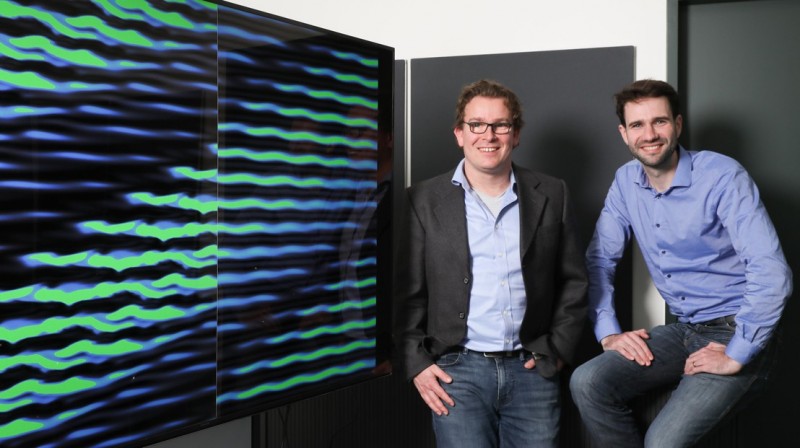
 Tobias Schneider and Florian Reetz
Researchers from EPFL have found the mechanism that lies behind a mysterious physics phenomenon in fluid mechanics: the fact that turbulence in fluids spontaneously self-organizes into parallel patterns of oblique turbulent bands - an example of order emerging spontaneously from chaos. In so doing, they solved a problem that had stumped generations of physicists. For decades, physicists, engineers and mathematicians failed to explain a remarkable phenomenon in fluid mechanics: the natural tendency of turbulence in fluids to move from disordered chaos to perfectly parallel patterns of oblique turbulent bands. This transition from a state of chaotic turbulence to a highly structured pattern was observed by many scientists, but never understood. At EPFL's Emerging Complexity in Physical Systems Laboratory, Tobias Schneider and his team have identified the mechanism that explains this phenomenon. Their findings have been published. From chaos to order The equations used to describe the large variety of phenomena occurring in fluid flows are well known.
TO READ THIS ARTICLE, CREATE YOUR ACCOUNT
And extend your reading, free of charge and with no commitment.
Your Benefits
- Access to all content
- Receive newsmails for news and jobs
- Post ads