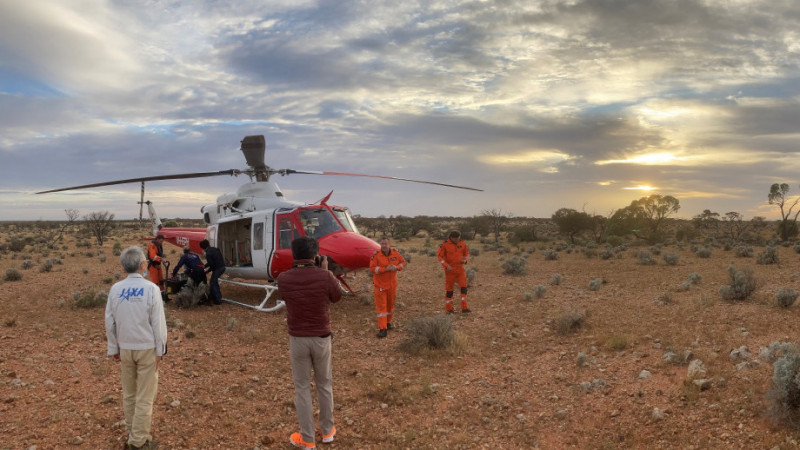
Scientists at Woomera conduct a ’dress rehearsal’ for finding and collecting the Hayabusa2 sample capsule when it lands. Image credit: Trevor Ireland, ANU
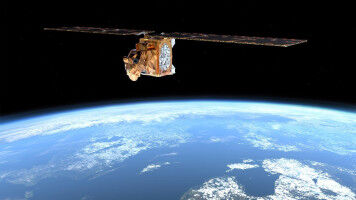
Scientists at Woomera conduct a 'dress rehearsal' for finding and collecting the Hayabusa2 sample capsule when it lands. Image credit: Trevor Ireland, ANU - A Japanese space mission will deliver samples collected from asteroid Ryugu in a capsule to the outback desert of Woomera in South Australia this Sunday morning. A leading expert from The Australian National University (ANU) who will analyse the samples says they could provide major insights into the origin of life on Earth. The subsurface material collected from the asteroid will be dropped off by Hayabusa2. Testing will start almost immediately on the returned material. The mission aims to shed light on the nature of asteroids and the origins of planets in our solar system, as well as the origin of Earth's water, which is vital for all life. ANU space rock expert Professor Trevor Ireland, who is on the Hayabusa2 science team, is in Woomera awaiting the arrival of the asteroid sample, which he will analyse in the lab. "I anticipate that the Hayabusa2 samples of asteroid Ryugu will be very similar to the meteorite that fell in Australia near Murchison, Victoria, more than 50 years ago," Professor Ireland, from the ANU Research School of Earth Sciences, said. "The Murchison meteorite opened a window on the origin of organics on Earth because these rocks were found to contain simple amino acids as well as abundant water." Professor Ireland said his work would help answer big questions about the diamond-shaped asteroid, which is about one kilometre in diameter and in an orbit that takes it between Earth and Mars. "We will examine whether Ryugu is a potential source of organic matter and water on Earth when the solar system was forming and whether these still remain intact on the asteroid," he said.
TO READ THIS ARTICLE, CREATE YOUR ACCOUNT
And extend your reading, free of charge and with no commitment.