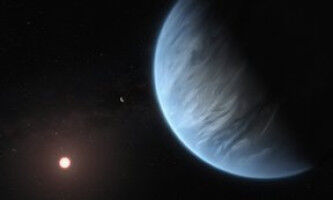
Artist's impression of black hole collision. Credit: Alex Andrix. NB: The streams and lensing around the compact objects are an artistic impression.
Artist's impression of black hole collision. Credit: Alex Andrix. NB: The streams and lensing around the compact objects are an artistic impression. A black hole around 23 times the size of the Sun has swallowed a mysterious, much smaller astrophysical object, according to new research announced today by the LIGO and Virgo gravitational wave observatories, including scientists from The Australian National University (ANU). The gravitational waves from this surprising event were detected by the LIGO and Virgo detectors on 14 August 2019 with the signal coming from a distance of around 800 million light years. Researchers think the mystery object is most likely either the lightest black hole or possibly the heaviest neutron star ever discovered. Neutron stars are formed during the explosion of a giant star and are the smallest and densest type of star in the Universe.
TO READ THIS ARTICLE, CREATE YOUR ACCOUNT
And extend your reading, free of charge and with no commitment.