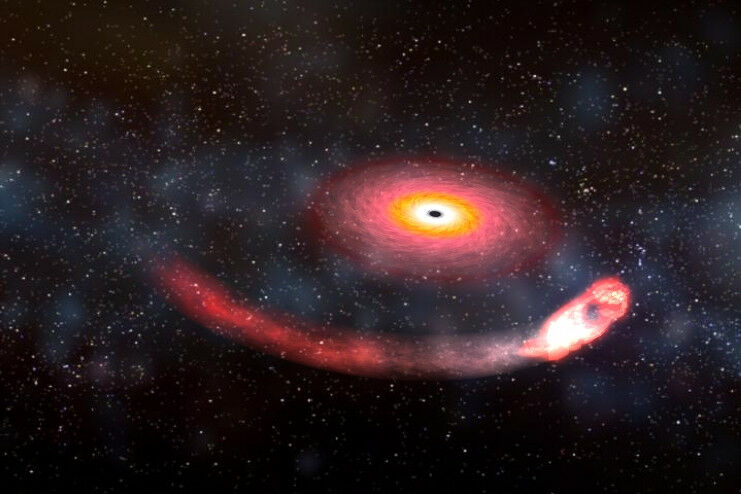
Artist’s impression of a black hole merging with a neutron star.
Artist's impression of a black hole merging with a neutron star. In a paper that appeared in the journal Physical Review Letters this week, astrophysicists from the University of Amsterdam propose a new way of potentially detecting dark matter. Astrophysicists Thomas Edwards, Marco Chianese and Bradley Kavanagh, from the groups of Samaya Nissanke and Christoph Weniger at the GRAPPA center of excellence, have studied the gravitational waves produced by the merger of a neutron star and a black hole. They found that these waves are slightly altered if a certain type of dark matter is present. Dark matter. Dark matter is an elusive form of matter, thought to account for about a quarter of the Universe's energy density. It does not interact with any other forces than gravity and can therefore not be 'seen'.
TO READ THIS ARTICLE, CREATE YOUR ACCOUNT
And extend your reading, free of charge and with no commitment.