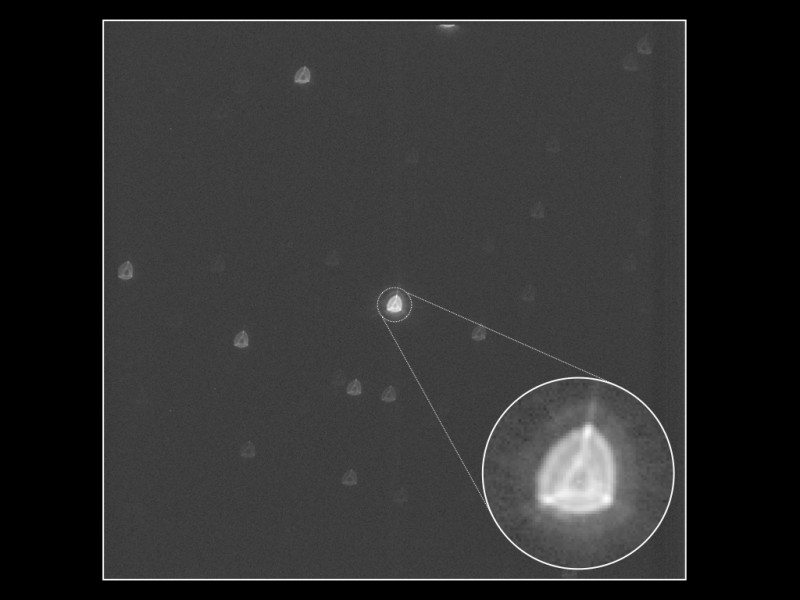
 First image of the star chosen as target for CHEOPS after cover opening. The star, at the centre of the image, is located at a distance of 150 light-years from us, in the constellation of Cancer. The image is about 1000x1000 pixels in size, with each pixel representing a tiny angle of about 0.0003 degree (1 arcsecond) on the sky. The other, fainter stars in the image are in the background of the target. The inset in the lower right corner shows a region of about 100-pixels in width, centered on the target star. The peculiar shape of the star in the image is due to the deliberate defocusing of CHEOPS optics. CHEOPS measures the star’s brightness by adding up the light received in all pixels within a region centered on the star as illustrated by the circle in the picture. The defocusing spreads the light onto many pixels, which allows CHEOPS to reach best possible photometric precision.
First image of the star chosen as target for CHEOPS after cover opening. The star, at the centre of the image, is located at a distance of 150 light-years from us, in the constellation of Cancer. The image is about 1000x1000 pixels in size, with each pixel representing a tiny angle of about 0.0003 degree (1 arcsecond) on the sky. The other, fainter stars in the image are in the background of the target. The inset in the lower right corner shows a region of about 100-pixels in width, centered on the target star. The peculiar shape of the star in the image is due to the deliberate defocusing of CHEOPS optics. CHEOPS measures the star's brightness by adding up the light received in all pixels within a region centered on the star as illustrated by the circle in the picture.
TO READ THIS ARTICLE, CREATE YOUR ACCOUNT
And extend your reading, free of charge and with no commitment.
Your Benefits
- Access to all content
- Receive newsmails for news and jobs
- Post ads