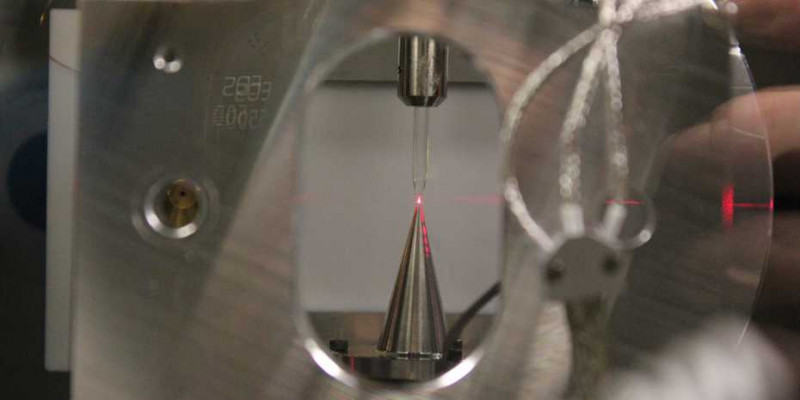
The scientists inject water from above into the analysis chamber, where it forms a short microjet that meets a laser beam. (Photograph: ETH Zurich / Inga Jordan)
The scientists inject water from above into the analysis chamber, where it forms a short microjet that meets a laser beam. (Photograph: ETH Zurich / Inga Jordan) - Electrons are able to move within molecules, for example when they are excited from outside or in the course of a chemical reaction. For the first time, scientists have now succeeded in studying the first few dozen attoseconds of this electron movement in a liquid. To understand how chemical reactions begin, chemists have been using super-slow motion experiments for years to study the very first moments of a reaction. These days, measurements with a resolution of a few dozen attoseconds are possible. An attosecond is 1x10-18 of a second, i.e. a millionth of a millionth of a millionth of a second. "In these first few dozen attoseconds of a reaction, you can already observe how electrons shift within molecules," explains Hans Jakob Wörner, Professor at the Laboratory of Physical Chemistry at ETH Zurich.
TO READ THIS ARTICLE, CREATE YOUR ACCOUNT
And extend your reading, free of charge and with no commitment.