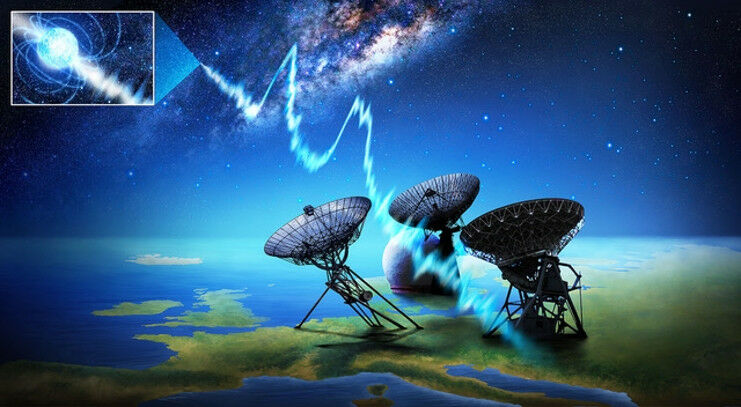
Artist’s conception of a magnetar with the 4 different telescopes that were used to observe it.
Artist's conception of a magnetar with the 4 different telescopes that were used to observe it. By studying the site of a spectacular stellar explosion seen in April 2020, a team of scientists including many from the Anton Pannekoek Institute of the University of Amsterdam have used four European radio telescopes to confirm that astronomy's most exciting puzzle is about to be solved. Fast radio bursts, unpredictable millisecond-long radio signals seen at huge distances across the universe, are generated by extreme stars called magnetars - and are astonishingly diverse in brightness. For over a decade, the phenomenon known as fast radio bursts has excited and mystified astronomers. These extraordinarily bright but extremely brief flashes of radio waves - lasting only milliseconds - reach Earth from galaxies billions of light years away. In April 2020, one of the bursts was for the first time detected from within our galaxy, the Milky Way, by radio telescopes CHIME and STARE2. The unexpected flare was traced to a previously-known source only 25 000 light years from Earth in the constellation of Vulpecula, the Fox, and scientists all over the world coordinated their efforts to follow up the discovery.
TO READ THIS ARTICLE, CREATE YOUR ACCOUNT
And extend your reading, free of charge and with no commitment.