Image: HIMS.
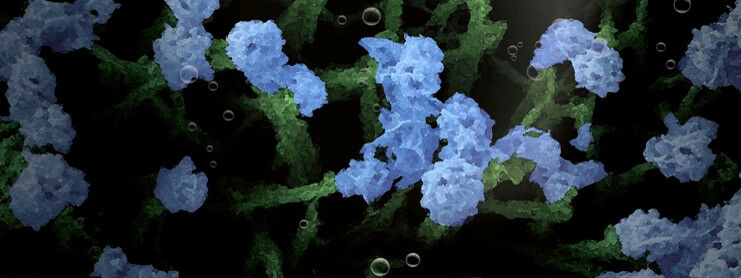
Image: HIMS. Easily produced, nature-like nanostructures of cobalt phosphide are highly effective catalysts for the electrolysis of water, according to research performed by chemist Ning Yan and his team at the University of Amsterdam's Van 't Hoff Institute for Molecular Sciences together with co-workers from the School of Physics and Technology at Wuhan University, China. In a 'hot paper' featured on the front cover of the Journal of Materials Chemistry A, they describe how relatively straightforward electrochemical deposition methods yield grass-, leaveand flower-like nanostructures that carry the promise of efficient hydrogen generation. For preparing nanostructures, top-down approaches such as lithography have since long been common. This has proven to be quite useful in semiconductor fabrication, but for more dedicated applications it is rather time-consuming and not particularly cost-effective. As an alternative, many researchers explore the bottom-up synthesis of nanostructures, for instance based on the self-assembly of molecules or nanoscale building blocks. However, achieving geometry control here often requires costly additives and surfactants, rendering large-scale material preparation quite challenging.
TO READ THIS ARTICLE, CREATE YOUR ACCOUNT
And extend your reading, free of charge and with no commitment.